

Best Books for Your Retirement Planning in 2024
POSTED ON
Planning for retirement can be a daunting task, but it doesn't have to be. With the right resources, you can gain the knowledge and confidence needed to secure your financial future. One of the best ways to educate yourself about retirement planning is by reading books written by experts in the field.
Books on retirement planning offer a wealth of information, covering everything from investment strategies to understanding social security benefits. They provide practical advice that you can apply to your own financial situation. Whether you're just starting to think about retirement or are nearing the end of your career, there's a book out there that can help you.
In 2024, there are many excellent books available that can guide you through the complexities of retirement planning. They are written in an easy-to-understand manner, making complex financial concepts accessible to everyone. By investing time in reading these books, you can make informed decisions and ensure a comfortable and secure retirement.
1st Book: Dave Ramsey’s The Total Money Makeover
Comprehensive Financial Overhaul
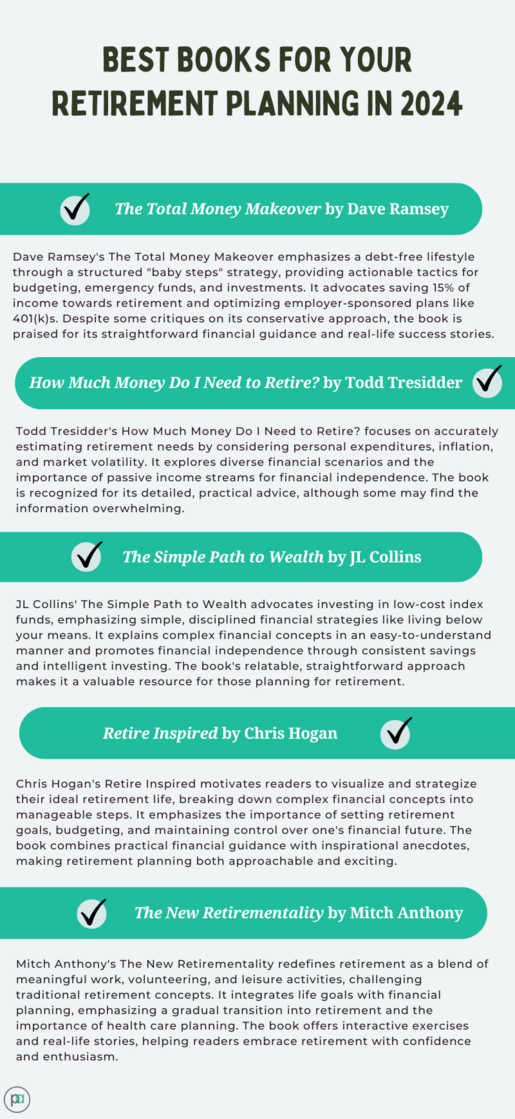
Frequently recommended for financial planning, The Total Money Makeover by Dave Ramsey establishes a solid framework for retirement planning as well. The book stands on the pillar of a debt-free lifestyle achieved through the well-articulated "baby steps" strategy.
This comprehensive guide brings together actionable tactics for budgeting, establishing emergency funds, and investment strategies targeted for a comfortable retirement. Ramsey holds steady on the belief in a disciplined financial lifestyle, which he views as the key to attaining long-term financial stability. To exemplify the effectiveness of his plan, the book shares real-life success stories of individuals who have been able to transform their financial futures following his advice.
Core Retirement Planning Principles
The book's primary focus is constructing a sound financial foundation before entering the retirement phase. Through his detailed analysis, Ramsey highlights the significance of saving at least 15% of one’s income for retirement funds.
Readers are prompted to optimize their employer-sponsored retirement plans, such as 401(k)s, which can significantly contribute to their savings. The book also provides insights into choosing suitable investment options, with the overall aim of maintaining a well-diversified portfolio. As retirement inches closer, Ramsey recommends transitioning towards more conservative investment options to minimize the risk factor.
Critical Reviews and Reader Feedback
In financial literature, the book receives recognition for its candid and straightforward approach to monetary management. However, some detractors contend that some of Ramsey's recommendations may be overly conservative or simplistic to handle complex market situations.
Reader testimonials and real-life application of the book's principles play a significant role in its popularity, offering a first-hand perspective on the practical effectiveness of the strategies. Another distinct element of Ramsey's work is his usage of religious undertones, which, while inspirational for some, might not resonate with everyone.
Notwithstanding the criticism, this work receives widespread respect for its potential to help families and individuals achieve the coveted state of long-term financial freedom. These diverse perspectives further underscore that the benefits derived from financial literature can be subjective and often depend upon the reader's personal financial circumstances and their interpretation of the advice provided.
2nd Book: How Much Money Do I Need to Retire? by Todd Tresidder
Estimating Retirement Needs
Todd Tresidder’s book dives into the nitty-gritty of calculating the funds required for a secure retirement. Encompassing often overlooked personal expenditures and potential future costs; it rightly emphasizes the necessity of understanding your own financial landscape before making grand plans.
Adding further value, the book broadens perspectives by exploring varied financial scenarios. Each one provides a distinct blueprint to help readers custom-fit a retirement strategy that caters to their lifestyle and goals. To aid this, Tresidder has included simple mathematical models that assist in projecting retirement savings requirements. He also reminds readers to take into account additional factors like inflation, market volatility, and unexpected expenses.
Financial Independence and Risk Management
Choosing to venture beyond traditional retirement advice, the book encourages readers to adopt financial plans that fit their unique needs. Shedding light on the concept of financial independence and early retirement (commonly known as the FIRE movement), the book delves into the integral role passive income streams play in successful retirement planning.
Providing advice on striking the right balance between investment risks and the necessity of stable income sources, Tresidder advocates for a prudent financial stance. He places noteworthy emphasis on diversifying investments, a time-tested strategy to withstand potential market turmoil.
Realistic and Actionable Advice
The practical, real-world applicability of Tresidder's advice is often applauded in reviews, adding value to the average retiree seeking guidance. It's worth noting, however, that critics are eager to point out that the wealth of information could potentially overwhelm someone new to financial planning.
In spite of this, the book's detailed examples, clear explanations, and down-to-earth writing style make it an easily digestible read for retirees. Recognized as an excellent complement to broader financial planning books, it succeeds in offering realistic and actionable advice.

3rd Book: The Simple Path to Wealth by JL Collins
Wealth Building
JL Collins’ The Simple Path to Wealth takes a straightforward approach to wealth building. The book originated from advice Collins gave his daughter, making it relatable and easy to comprehend. The primary focus is on the benefits of investing in low-cost index funds. Collins encourages living below your means and taking up intelligent investing as the main wealth-building strategies. He uses simple, understandable language to explain complex financial concepts.
Core Investment Strategies
Collins advocates for a minimalist investment strategy centered on the Vanguard Total Stock Market Index Fund. The book provides thorough explanations of compound interest, tax advantages, and the power one can obtain by saving early and frequently. He recommends avoiding financial advisors who might have conflicting interests. Understanding market cycles and maintaining a long-term vision are emphasized. Collins offers guidance on staying disciplined and steering clear of making emotional financial decisions.
How to Achieve Financial Freedom
The focus of the book shifts to achieving financial freedom and independence through disciplined investing. Collins gives practical advice on managing and minimizing debt to enhance your savings potential. He introduces readers to the concept of F-You Money, the idea of having enough savings to be able to walk away from unfulfilling jobs. Collins' personal anecdotes drive home the importance of financial independence. He also suggests strategies for low-cost living, which can significantly speed up your path to wealth creation.
Its simplicity in presentation and clear guidance make the book a noteworthy resource for retirement planning. The book avoids complex jargon and opts for an understandable and direct approach to long-term financial abundance. For those planning for retirement, Collins' words serve as an ideal roadmap. His philosophy of wealth as freedom gives readers a new perspective on financial independence. The book instills confidence, allowing individuals to take control of their finances confidently.
4th Book: Chris Hogan's Retire Inspired
Inspirational Approach to Retirement
Chris Hogan's book Retire Inspired takes retirement planning and makes it something to look forward to with excitement and inspiration. Hogan urges his readers to visualize their ideal retirement life and strategize backward. Complex financial constructs are simplified into bite-sized sections, making them easy for everyone to understand. Personal anecdotes and client testimonials are sprinkled throughout the book to provide success stories as evidence of the effectiveness of Hogan's advice. The book places significant emphasis on the psychological aspects of retirement planning.
Practical Financial Guidance
Retire Inspired hits home with the significance of establishing retirement goals and deadlines. It houses a detailed action plan involving budgeting, nurturing retirement funds, and implementing sophisticated investment strategies. It drives the point of securing and maintaining control over one's financial future rather than outsourcing critical decisions.
The book is aimed not just at simplifying retirement planning but at equipping readers with the necessary tools to overcome common financial fears and misconceptions. From the labyrinth of social security benefits to the intricacies surrounding pension plans, the book lays it all out in a digestible format.
Building Confidence in Financial Planning
Hogan's book uses real-life case studies as a source of practical inspiration for its readers. It highlights key retirement milestones and the significance of celebrating financial achievements. This approach resonates with readers, with reviews emphasizing Hogan’s engaging and comprehensive demystification of retirement. However, critics suggest some advice may require individual tweaking for personalized effectiveness.
Activity aside, Retire Inspired stands as a pillar of motivational and actionable content on retirement planning. It encourages readers to have a financially stable retirement but also one that is fulfilling, characterized by achieving their dreams and living life on their own terms.
5th Book: The New Retirementality by Mitch Anthony
Redefining Retirement
Mitch Anthony's The New Retirementality poses a challenge to the traditional concepts of retirement, advocating for a more versatile and adaptive approach to retirement planning. Instead of viewing retirement as a complete halt of activities, readers are encouraged to pursue meaningful work and activities throughout their retirement years. The book delves into the changing face of retirement in today's society, suggesting a blend of part-time work, volunteering, and leisure activities as an alternative model.
Financial Planning and Life Design
In this new paradigm, financial planning aligns not just with financial security but also with personal passions and pursuits. The New Retirementality emphasizes a holistic approach to retirement planning, integrating life goals with financial objectives. Anthony provides strategies for gradually transitioning into retirement to maintain financial stability, discussing the crucial role of healthcare planning and insurance considerations. Readers are encouraged to design a retirement plan tailored to their individual needs, allowing for personal growth and satisfaction even in their retirement years.
Engaging the Reader
The New Retirementality is brimming with interactive exercises to help readers assess their readiness for retirement. Anthony emphasizes the importance of adaptability in today's fast-changing world. The book provides insights into handling the emotional and psychological aspects of retirement, filled with stories and examples from retirees who have redrawn the lines of what retirement should look like.
Anthony balances these thoughtful insights with practical guides and interactive exercises, encouraging readers to assess their individual readiness for retirement. These hands-on elements offer a self-reflective journey to the reader, grounding the concepts in everyday life and making the prospect of retirement planning less daunting.
Complementing these exercises are the heartening stories of retirees who have successfully navigated this change. Their examples illuminate the path for readers, delivering practical and lived advice. Anthony's engaging style turns complex retirement concepts into approachable and even exciting ideas. This valuable guide helps readers cast away anxiety and embrace their retirement years with confidence and enthusiasm.
Finding Your Perfect Retirement Guide
The journey of retirement planning is unique to each individual, and the right guidance can make all the difference. From Dave Ramsey's disciplined financial approach to JL Collins' straightforward wealth-building strategies, there's a wealth of knowledge available to help you navigate your retirement planning. These books provide not only practical financial advice but also motivational insights that can transform how you view and prepare for your retirement.
Taking the time to read and understand these varied approaches can equip you with the tools to make informed decisions tailored to your personal circumstances. Each book offers a distinct perspective, whether it's the emphasis on asset protection, the importance of emotional readiness, or innovative financial strategies. You can create a thorough retirement plan that addresses all of your needs by incorporating these insights into your planning.
The key takeaway is that retirement planning is more than just securing your finances; it’s about creating a fulfilling and enjoyable retirement life. These resources can guide you toward achieving both financial stability and personal satisfaction. If you're ready to take the next step in your retirement planning journey and need personalized advice, reach out to Partners in Aging today. Our expert team can help you navigate the complexities of retirement planning and ensure you’re well-prepared for the future.