

The Importance of Leaving a Legacy
POSTED ON
Humans have always been driven to make an enduring impact, hoping that their life’s work, values, and love will continue to influence future generations. Leaving a legacy isn’t just about wealth—it’s about ensuring that your life leaves meaningful footprints for others to follow. A well-planned legacy reflects your values, protects your family’s future, and can even benefit society through charitable acts.
This article explores various methods for leaving a lasting legacy, focusing on estate planning tools, wealth transfer strategies, and how to safeguard your legacy for future generations. Whether you are planning in advance or adapting to sudden life changes, these insights will help you protect your assets and ensure your values endure.
Understanding estate planning is essential for anyone who wishes to create a lasting legacy. By learning the various tools and legal frameworks available, you can make sure that your wealth and values are passed down according to your wishes. Let's dive into the steps, tools, and strategies that will help you achieve this.
Understanding Estate Planning
What Is Estate Planning?
Estate planning is a proactive process involving the arrangement of management and disposal of an individual's estate in the event of their incapacitation or demise. It aims to streamline the legal transfer of your assets to your designated beneficiaries while minimizing gift, estate, generation-skipping transfer, and income tax.
A comprehensive estate plan also encompasses setting up healthcare directives and powers of attorney, a crucial step to ensure that your medical and financial preferences are honored if you become incapacitated. To meet peculiar goals such as supporting philanthropy or catering to kin with special needs, setting up specific types of trusts like charitable or special needs trusts can be beneficial.
Why Estate Planning Is Important
Estate planning is not just essential but indispensable as it safeguards your assets for your heirs. A well-strategized estate plan prevents assets from being eroded by the expensive and lengthy probate process. It is instrumental in executing your preferences in case of incapacity or death and promotes smooth asset transfer.
A strategic estate plan is also a safety net for family members with special needs, ensuring they get the required support without forfeiting their government benefits.
Who Should Be Involved in Planning a Legacy?
A holistic and effective estate plan usually involves a team of professionals, including an estate planning attorney and a financial advisor. Additionally, tax advisors and fiduciaries often play an essential part in crafting the plan. In certain cases, charitable organizations and family members are also involved if endowments are intended.
Investment and wealth management experts, known as financial planners and advisors, can assist in structuring your portfolio for optimal growth and risk reduction. They can also provide guidance on retirement plans and education funding strategies. Healthcare professionals and long-term care planners can offer critical assistance in factoring in future healthcare needs and long-term care to ensure your financial and estate plans cover medical expenses and care requisites without exhausting your legacy.
What Are the Common Estate Planning Tools?
1. Wills
A will is a quintessential legal document that carries your voice after death. It specifies how you want your assets managed and distributed. Wills are required to pass through probate, a court-supervised process that validates the same and properties. It's crucial to appoint an executor in your will, awarding them the authority to handle your affairs after passing. For those with minor children, wills offer a legally secure platform to assign guardianship.
2. Revocable Living Trusts
Unlike your regular will, a Revocable Living Trust provides the double-edge benefit of lifespan utility and post-death specificity. You create this type of trust during your lifetime, positioning your assets in it, and detailing how they should be distributed after death. An edge of this tool is its escape from probate, offering privacy to your financial matters. Even after establishing a trust, you continue to exercise control and can make amendments as necessary.
3. Beneficiary Designations
Specific financial and investment accounts, such as retirement accounts, life insurance policies, and bank/investment accounts, dispense assets directly to named beneficiaries upon your death—no probate. For the sake of accuracy and present wishes, these beneficiary nominations should be routinely updated. In the event of conflict, the nominations in your beneficiary designations override that stated in a will.
4. Joint Ownership
Joint ownership is common among spouses and operates around legal structures - owning an asset jointly with rights of survivorship means the surviving owner or owners automatically inherit the deceased owner's share. This law bypasses probate, and in many cases, it is also tax-efficient. However, legal implications call for careful consideration for all types of property, keeping in mind it might not always serve as the best option.
5. Transfer-on-Death (TOD) Deeds and Payable-on-Death (POD) Accounts
Transfer-on-death or TOD deeds permit real estate in certain states to pass directly to designated beneficiaries, omitting the probate process. Similarly, payable-on-death or POD accounts apply to bank accounts intended to be inherited by a specific individual on your demise. This system offers a simplistic approach to estate planning, entirely circumventing the hassles of probate. However, updating beneficiaries regularly and ensuring clear naming is vital in this process. Specific rules and forms might apply in some states for effectiveness.
6. Gifting During Lifetime
One feasible method to transfer assets and reduce estate taxes is to gift your heirs while you are still alive. Certain provisions allow annual exclusion gifts, an amount that can be gifted each year tax-free. However, it is not devoid of its considerations and necessitates appropriate documentation for tax records. Although capable of providing timely help to heirs when they most need it, gifting high-value assets like properties may come with tax implications.
7. Irrevocable Trusts
Irrevocable trusts offer an umbrella of types tailored for asset transfer with potential tax benefits. Once such a trust is established, modifications aren't possible without consent from the beneficiaries. These types are popular for shielding assets from taxes and creditors, serving as a robust tool for long-term asset management. Special types, like Generation-Skipping Trusts, empower passing assets to far-out generations such as grandchildren.
8. Life Insurance and Charitable Remainder Trusts
Life insurance possesses the great advantage of directly passing the proceeds to the named beneficiaries, and that too, tax-free. Charitable Remainder Trusts are a unique estate planning tool, doling out the estate income to heirs for a specific period, subsequently donating the remainder to a charity. Such tools not only provide a steady income stream to heirs but also proffer significant tax advantages and serve philanthropic goals.
9. Qualified Personal Residence Trusts (QPRTs) and Family Limited Partnerships
The tactic of transferring a primary residence or a vacation home to heirs is affected through the employment of Qualified Personal Residence Trusts or QPRTs. It serves as a viable solution to transform a high-value asset into a gift while maintaining the right to live in the home. Similarly, Family Limited Partnerships or LLCs facilitate the gradual transfer of business interests to family members, effectively managing business succession plans, and offer potent tools for tax reduction.
Let's revise your article to meet your specifications, ensuring a smooth flow, three-paragraph introduction and conclusion, and clear, easy-to-understand language. I will also reformat the headings into questions to directly address the key points, add additional information for depth, and incorporate the CTA for Partners in Aging. I'll begin by outlining the revised structure and expanding the content as needed.
Why Is Leaving a Legacy Important?
Humans have always been driven to make an enduring impact, hoping that their life’s work, values, and love will continue to influence future generations. Leaving a legacy isn’t just about wealth—it’s about ensuring that your life leaves meaningful footprints for others to follow. A well-planned legacy reflects your values, protects your family’s future, and can even benefit society through charitable acts.
This article explores various methods for leaving a lasting legacy, focusing on estate planning tools, wealth transfer strategies, and how to safeguard your legacy for future generations. Whether you are planning in advance or adapting to sudden life changes, these insights will help you protect your assets and ensure your values endure.
Understanding estate planning is essential for anyone who wishes to create a lasting legacy. By learning the various tools and legal frameworks available, you can make sure that your wealth and values are passed down according to your wishes. Let's dive into the steps, tools, and strategies that will help you achieve this.
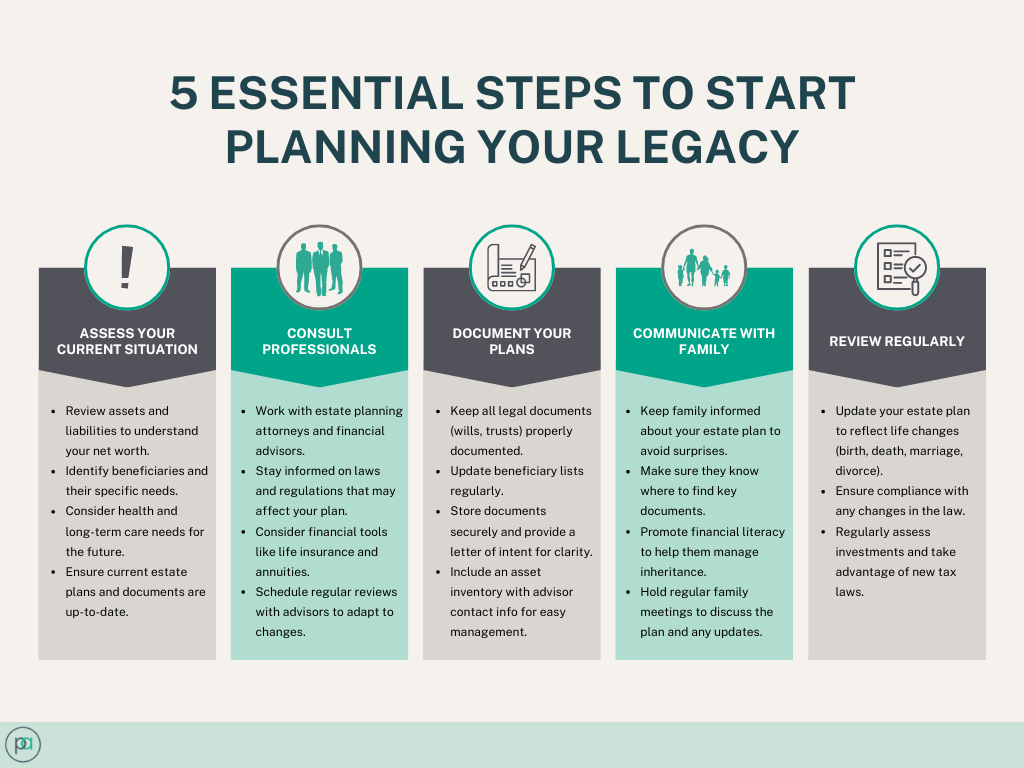
What Steps Should You Take to Start Planning Your Legacy?
1. Assess Your Current Situation
Begin the process of securing your legacy by examining your current situation. This involves reviewing your existing assets and liabilities to accurately understand your net worth. Identification of your beneficiaries and their prospective needs is crucial. Keep in mind any health and long-term care needs that may arise in the future.
Evaluate the level of financial knowledge both you and your heirs possess as it can impact your planning process. If you already have any estate plans or legal documents in place, ensure they still align with your objectives and are up to date.
2. Consult Professionals
Professional advice can provide the best strategies for your unique situation. Estate planning attorneys and financial advisors can ensure you leverage the most effective tools while keeping abreast of changes in laws and regulations. Utilize recommended financial tools and products such as life insurance policies and annuities to safeguard your assets. Allocating time for regular reviews of your estate plan with your advisors will ensure your plan stays current and can adapt to any changes.
3. Document Your Plans
Proper documentation of your estate plan, including all legal documents, is pivotal. It's important to consistently review and update your list of named beneficiaries. Your documents should be stored in a secure yet accessible place. Providing a letter of intent—a personal note that outlines your wishes and reasons behind key decisions—may offer clarity and prevent misunderstandings. Moreover, a detailed inventory of all assets, including contact information of important personas like your financial advisor, is invaluable in ensuring efficient management and transfer of assets by your chosen executors or trustees.
4. Communicate With Family
Keeping your family in the loop with your plans can avoid surprises down the line. Ensure they know where to locate important documents and have a clear understanding of your wishes. Promote financial literacy within the family; a sound grasp of investments, savings, and financial planning can be key to managing inheritance responsibly. Regular family meetings present the perfect platform for discussing your estate plan, financial goals, and any changes to your circumstances.
5. Review Regularly
Ensure your estate plan stays up to date with your life. This includes updating it to reflect any life changes such as births, deaths, marriages, or divorces. It's important for the plan to stay compliant with changes in laws and conform to your personal circumstances. Ongoing assessment of your investment strategies to mirror market changes and new opportunities is paramount. Don't overlook the implications of tax and take advantage of new tax laws or exemptions whenever possible.
How Can You Gift Assets During Your Lifetime?
What Are the Benefits and Drawbacks of Lifetime Gifting?
Lifetime gifting is a way to pass assets to your heirs while you are still alive, potentially reducing estate taxes. You can make annual exclusion gifts, which are tax-free up to a certain amount. While gifting can provide immediate financial support to your heirs, it can also have tax implications, especially for high-value assets. Proper documentation is essential to avoid complications.
How Do Irrevocable Trusts Protect Your Assets?
An irrevocable trust transfers assets out of your ownership, protecting them from taxes and creditors. Unlike revocable trusts, changes to irrevocable trusts are challenging to make without the consent of beneficiaries. These trusts can be powerful tools for preserving wealth across generations, particularly through strategies like Generation-Skipping Trusts, which pass assets directly to grandchildren or even further down the line.
What Role Does Life Insurance Play in Legacy Planning?
How Can Life Insurance Benefit Your Heirs?
Life insurance is a vital estate planning tool because it provides tax-free payouts directly to named beneficiaries. This ensures that your heirs receive financial support without the delays and expenses of probate. Additionally, Charitable Remainder Trusts can provide income to heirs for a set period, with the remaining assets eventually going to a charity, aligning with philanthropic goals while offering tax benefits.
How Do Qualified Personal Residence Trusts (QPRTs) Work?
QPRTs allow you to transfer a primary residence or vacation home to your heirs while continuing to live in the property. This reduces the property’s taxable value, potentially lowering estate taxes. Family Limited Partnerships or LLCs can also help manage the transfer of business assets to heirs while offering tax advantages.
Securing Your Legacy: Essential Estate Planning Tools and Strategies
Creating a thoughtful and well-structured legacy plan is one of the most meaningful gifts you can leave behind. By utilizing estate planning tools such as wills, trusts, and beneficiary designations, you can ensure your wealth is transferred according to your wishes and that your loved ones are protected. It's important to not only think about the assets you leave but also how your values and life lessons can be passed down, leaving a lasting impact on future generations.
The key to successful legacy planning lies in proactive and regular reviews. Life changes, such as marriages, births, or shifts in financial situations, can all impact the effectiveness of your estate plan. By revisiting your plan and consulting professionals, you ensure your legacy remains aligned with your current circumstances and wishes. Incorporating tools like charitable trusts or gifting during your lifetime can further enhance the impact of your plan while minimizing tax liabilities.
If you’re ready to take the next step in safeguarding your legacy, Partners in Aging offers the expertise and guidance you need to navigate estate planning with confidence. Our team of professionals can help you craft a personalized plan that reflects your values, protects your assets, and secures your family’s future. Don’t wait—contact us and start planning today with the trusted advice of Partners in Aging to ensure your legacy lives on.