

Why an IRA Can’t Go Into a Trust and What to Do About It?
POSTED ON
Individual Retirement Accounts (IRAs) are important for saving money for retirement because they offer tax benefits. Many people think about combining IRAs with trusts to make their estate planning stronger. However, this combination is tricky because of the complicated tax rules involved.
Trusts are used to manage and protect assets for your loved ones, but IRAs have specific rules about who can own them. Understanding these rules is key to making the best choices for your financial future. If you want to know why IRAs can't go directly into a trust and some smart strategies to work around these limitations, then you’ve come to the right place.
What Are the Limitations of Putting an IRA into a Trust?
Restrictions on IRA Owners
1. IRA owners must understand the IRA trust limitations that prevent the direct transfer of IRA assets into a trust while the IRA owner is still alive. This restriction guarantees that the tax advantages specific to IRAs remain with the individual owner, which is crucial for effective estate planning.
2. Transfer of Ownership: Trusts can’t own IRA assets during the IRA owner’s lifetime. Since individual IRA accounts must be owned by individuals, an IRA trust is not permitted. This means that an IRA can’t be transferred into a trust while the original owner is alive, maintaining the IRA's tax advantages.
3. See-Through Trust Qualifications: For a trust to be considered a beneficiary of an IRA after the owner's death, it must qualify as a "see-through" trust. This is critical for estate planning involving IRA beneficiaries:
- The trust must be valid under state law and irrevocable upon the IRA owner’s death.
- The beneficiaries of the trust must be clearly identifiable. They must all be individuals to determine the life expectancy for Required Minimum Distributions (RMDs).
- Documentation confirming the trust's status must be provided to the IRA custodian by October 31 of the year following the IRA owner's death.
Distribution Rules: If the trust meets the criteria to be a see-through trust, the age of the oldest trust beneficiary determines the RMDs from the inherited IRA. This can potentially shorten the distribution period, which might not be as tax-efficient for younger IRA beneficiaries.
Taxation: Trusts are generally subject to higher income tax rates than individuals. If IRA distributions to the trust are accumulated within the trust (and not passed through to the trust beneficiaries), they can be taxed at these higher rates. This often results in less favorable tax treatment than distributions made directly to individual IRA beneficiaries.
Complexity and Costs: Using a trust as an IRA beneficiary adds complexity to estate planning. It requires careful drafting to comply with IRA and trust estate planning rules and may involve higher administrative costs and ongoing trustee fees.
Violating these regulations, particularly concerning required minimum distributions and the age-timing of contributions, can lead to severe tax penalties. This could significantly diminish the value of the IRA assets intended for the IRA beneficiary, emphasizing the need for careful planning and adherence to IRS guidelines.
What Are the Implications for the Trust as Beneficiary?
Designating a trust as an IRA beneficiary involves navigating complex IRS look-through rules. These rules are essential for allowing the trust beneficiaries to stretch the distribution of the IRA assets over their lifetimes, potentially extending the tax-deferred benefits beyond the IRA owner's death.
However, if the trust fails to meet the specific conditions to qualify as a see-through trust, the IRA assets may be subject to accelerated distributions. This scenario often results under the Five-Year Rule, requiring full distribution within five years if the trust does not satisfy IRS requirements, leading to potentially higher tax burdens for the IRA beneficiaries.
The Cons of IRAs as You Age
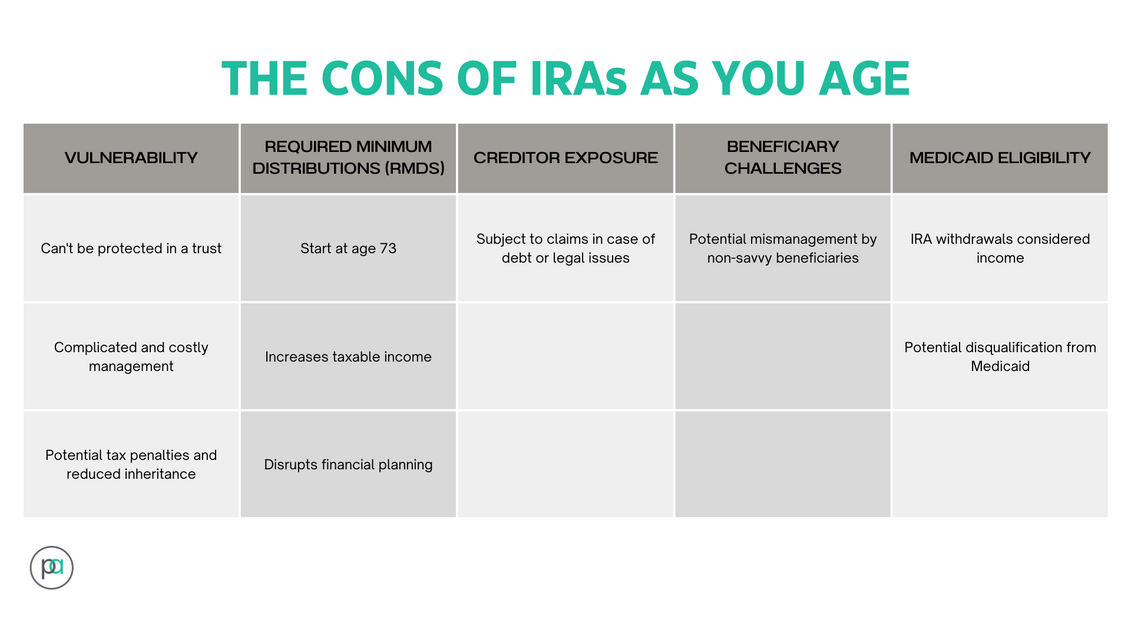
While IRAs offer significant tax advantages, they present notable drawbacks as you get older. One major issue is that IRA assets can’t be protected in a trust, making them vulnerable when planning for long-term care or passing on wealth. Without trust protection, managing these assets can become complicated and costly, potentially leading to tax penalties and reduced inheritance for beneficiaries.
Required Minimum Distributions (RMDs) starting at age 73 can force you to withdraw more money than needed, increasing your taxable income and possibly pushing you into a higher tax bracket. This can reduce the overall growth of your retirement savings. Additionally, these mandatory withdrawals can disrupt your financial planning, especially if you prefer to keep funds invested longer.
Creditors can also claim IRA assets, unlike assets placed in certain types of trusts that offer creditor protection. This leaves IRA assets exposed in case of significant debt or legal issues. Furthermore, if your IRA beneficiaries are not financially savvy, they might struggle to manage the inherited assets, potentially leading to poor financial decisions and further losses.
For older individuals, IRAs can also complicate Medicaid eligibility. Since IRA withdrawals are considered income, they could disqualify you from Medicaid or reduce the benefits you receive. This is especially concerning for those planning for long-term care, as Medicaid is a primary payer for such expenses.
What Are the Solutions to Mitigate Limitations?
To navigate these limitations, IRA owners can consider establishing a conduit trust or a see-through trust. These trusts are designed to comply with IRS rules, ensuring that IRA beneficiaries can benefit from extended distribution periods, which can significantly enhance the tax efficiency of IRA assets.
Another effective strategy is the conversion of traditional IRAs to Roth IRAs. This conversion can lead to tax-free growth and withdrawals, offering substantial benefits to the IRA beneficiaries. Directly naming beneficiaries on the IRA account is a simpler alternative that bypasses the complexities of trusts and avoids potential negative tax implications.
What Are the Alternatives That Will Allow You to Still Take Advantage of the Tax Savings of an IRA?
It's advisable to keep the IRA separate while directly naming IRA beneficiaries. This strategy simplifies the inheritance process and avoids the potential complexities and negative tax implications that might arise when a trust inherits an IRA. Direct beneficiary designations provide a straightforward method of asset distribution.
Converting a traditional IRA to a Roth IRA is another viable alternative. This conversion triggers upfront tax liabilities but benefits from tax-free growth and distributions, making it an attractive option for long-term estate planning. Roth IRAs provide significant advantages, particularly in terms of tax efficiency and ease of transfer to beneficiaries.
Using Charitable Remainder Trusts (CRTs) offers a strategic component in estate planning with IRAs. CRTs allow for charitable donations while providing substantial tax advantages, making them particularly valuable for larger IRA assets. This approach not only aids in tax planning but also supports philanthropic goals.
Allocating an IRA to minor beneficiaries under guardianship is a prudent strategy. This method controls the timing of withdrawals, ensuring that beneficiaries do not misuse the assets before reaching maturity. It also helps manage the tax implications associated with early IRA distributions.
In some cases, utilizing life insurance as part of your estate planning strategy can be highly effective. Life insurance provides a tax-free death benefit, which can replace the value of taxed IRA or trust assets, so beneficiaries receive the full intended value. This tool is particularly beneficial when anticipating significant taxes or the depletion of estate assets.
What Is the Future of IRA and Trust Estate Planning?
Estate planning laws and practices are constantly evolving. Recent legislative developments, such as the SECURE Act 2.0, promise significant impacts on how IRAs and trusts are managed within estate plans. These changes necessitate a deep understanding of new regulations to optimize estate strategies effectively.
The pandemic has introduced modifications to IRA distribution and withdrawal rules, adding complexity to retirement and estate planning. Recent tax reforms under the Biden administration have altered IRA contributions and deductions, which could influence your long-term financial planning. It's crucial for IRA owners and estate planners to stay informed about these changes and adjust their strategies accordingly.
Wrapping Up: What Are the Key Takeaways?
Naming a trust as an IRA beneficiary has inherent limitations and potential complications, such as severe tax penalties and complex RMDs. These issues can undermine the foundational goals of financial security and efficient wealth transfer. However, with the right strategies, these challenges can be effectively managed.
Conduit trusts, Roth IRA conversions, and direct beneficiary designations are strategic tools that can help circumvent the limitations of naming trusts as IRA beneficiaries. Employing these alternatives requires careful planning and advice from financial experts. It's essential to consult with seasoned estate planning professionals to ensure your estate plan is compliant and aligned with your financial goals.
Get in touch with Partners in Aging to ensure you are choosing what is best for your loved ones and yourself in the future. Our team of dedicated professionals can provide the guidance and expertise needed to navigate the complexities of estate planning. Contact us today to learn more about how we can help you secure your financial future and achieve peace of mind.
Frequently Asked Questions (FAQs) about IRAs, Trusts, and Estate Planning (Updated for 2024)
What are the main differences between a Traditional IRA and a Roth IRA?
- Traditional IRA: Contributions may be tax-deductible depending on your income, and distributions are taxed as ordinary income. Starting in 2024, the age for RMDs is updated to 73.
- Roth IRA: Contributions are made with after-tax dollars and do not provide a tax deduction. However, withdrawals are tax-free in retirement, and there are no RMDs, offering greater flexibility for estate planning.
How do I choose the right type of trust for my estate plan?
Choose based on your control preferences, potential tax benefits, and protection needs. Revocable trusts offer flexibility as they can be altered or revoked during your lifetime, making them ideal for those whose situations may change. Irrevocable trusts provide tax advantages and protect assets from creditors, but they can’t be changed once established.
What are some tips for reducing estate taxes through my estate plan in 2024?
Utilize annual gift tax exclusions to gradually reduce the size of your taxable estate. Consider setting up strategic trusts like irrevocable life insurance trusts (ILITs) to exclude the life insurance proceeds from your estate, thereby reducing estate taxes. Always keep abreast of changes in tax legislation, such as the adjustments that may come with ongoing reviews of tax laws.
Can an IRA be placed into a trust?
An IRA can’t be placed into a trust while the owner is alive, but you can name a trust as the beneficiary. As of 2024, ensure the trust qualifies under the updated SECURE Act 2.0 provisions to use the life expectancy of the trust beneficiaries for RMD calculations, which is only possible if the trust meets specific "see-through" criteria.
What are the tax implications of inheriting an IRA from a trust in 2024?
If a trust that inherits an IRA qualifies as a see-through trust, the RMDs are calculated based on the age of the oldest trust beneficiary and taxed as ordinary income. Non-qualified trusts must distribute the entire IRA within five years of the owner's death, potentially leading to higher tax burdens.